Every baby registry contains three categories of item: the things used daily, the things used twice, and the things still in the box when the baby turns one. The frustrating part is that the three categories look identical in a shop.
There is no universal list, because babies differ and so do houses. But after the first year most parents land on roughly the same conclusions about which purchases pulled their weight, and those conclusions have very little to do with price.
The Things That Get Used Every Single Day
A changing setup on every floor of the house. Not a second changing table, just a basket with nappies, wipes and a mat. The cost is almost nothing and it removes dozens of trips upstairs in the first months, which matters more than it sounds when recovering from birth.
A carrier that fits the adult wearing it. Carriers are the item most often bought on looks and most often abandoned over fit. A badly fitted one ends up in a cupboard within a fortnight because it hurts. If there is a sling library or a shop that lets you try before buying, that is worth more than any review.
Muslins, in an unreasonable quantity. Twice what seems sensible. They are burp cloths, sun shades, changing mats, mop-up rags and comfort objects, and they are in the wash constantly.
Something that makes nights require less thinking. More on this below, because it is the category that gets underestimated most.
The Things That Punch Above Their Price
A sound machine. Cheap, unglamorous, and it keeps working for years. It also masks the household noise that makes early bedtimes impossible in a flat or a house with older children.
Nappy cream in multiples. One by each changing station. The problem is never that it does not work, it is that it is always in the other room.
A thermometer for the nursery. Most people skip this one, but it can settle a common debate. A baby’s hands often feel cooler than the rest of their body. Well-meaning adults may add too many layers if they judge warmth by touch alone.
Knowing the room runs at 69 degrees rather than guessing turns a nightly judgement call into a fact. That thermometer connects to the other thing worth getting right.
Nights Are Where the Good Purchases Live
Current safe sleep guidance is that a crib stays bare: firm mattress, fitted sheet, nothing loose in it. Which leaves a reasonable question about warmth that most people resolve sometime around the first cold night.
A wearable blanket is the answer. Baby sleep sacks zip closed around a baby, leave the arms free, and cannot be kicked off, which is the part that matters.
The benefit is less about warmth in the abstract and more about nobody having to go in at 2am to re-cover a baby who has shed a blanket, because that trip is what wakes everyone properly.
Two things decide whether one works. Warmth is rated in TOG, and matching it to the room beats guessing: lower numbers for warm rooms, around 1.0 for a normally heated house most of the year, 2.5 for genuinely cold ones.
Fit runs opposite to instinct, snug at the neck and armholes so a baby’s head cannot slip through, roomy through the hips and legs so they can kick and bend freely. Sizing up to get another six months out of it defeats the first half of that.
Two in the weight being used covers the laundry cycle. A third is money that would be better spent on the correct TOG for the next season.

The Things That Mostly Sit in the Box
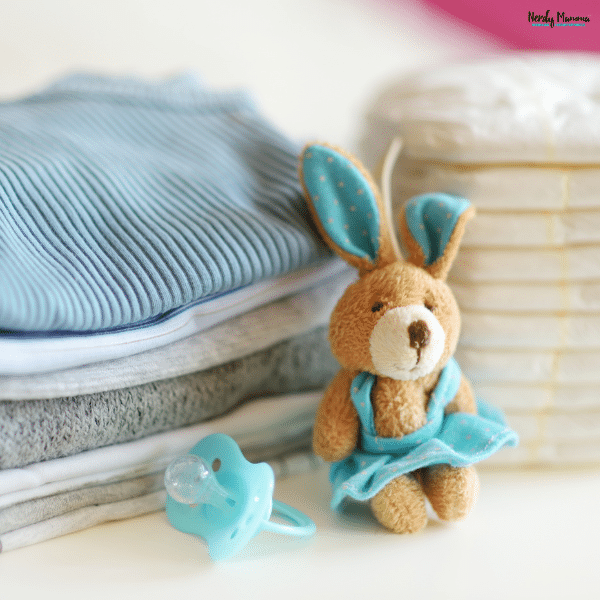
Newborn clothing in quantity. It fits for weeks, and a meaningful share of babies arrive too big for it. Two or three outfits is plenty and the rest should be 3 to 6 months.
Baby shoes. Decorative. Babies who are not walking do not need them and babies who are learning to walk do better barefoot.
The full bottle system bought in advance. Babies have opinions about bottles and those opinions are not predictable. One or two to start, then buy more of whichever one gets accepted.
Top-and-tail bowls, wipe warmers, nappy stackers. Single-purpose items solving problems that a flannel or a drawer already solves.
Most toys for the first six months. Babies at that age are interested in faces, high contrast patterns and whatever an adult is holding. A handful of simple things covers it.
What the Pattern Actually Is
The items that earn their place are boring and solve a logistics problem that recurs daily. The items that do not are usually solving a problem that occurs rarely, or solving a problem a cheaper item already solves, or solving no problem at all beyond looking good in a nursery.
Buy only the essentials before your baby arrives, then fill in the gaps as you go. Most retailers can deliver baby gear the next day. Waiting a few weeks gives you time to learn what your baby needs before you buy more.