As a DIY enthusiast, I think that a portable tool kit is a must-have. It contains all the tools and equipment needed for minor repairs instead of rummaging around in different drawers or in the garage for a screwdriver or a wrench.
Having a tool box allows me to perform minor tasks such as fixing something that requires a bit of hardware know-how, furniture assembly, put up some shelves, and even something as simple as a minor plumbing job with ease and efficiency.
In addition, having a fully equipped toolbox also gives confidence that I can indeed do the job.
Choosing the Right Storage Case
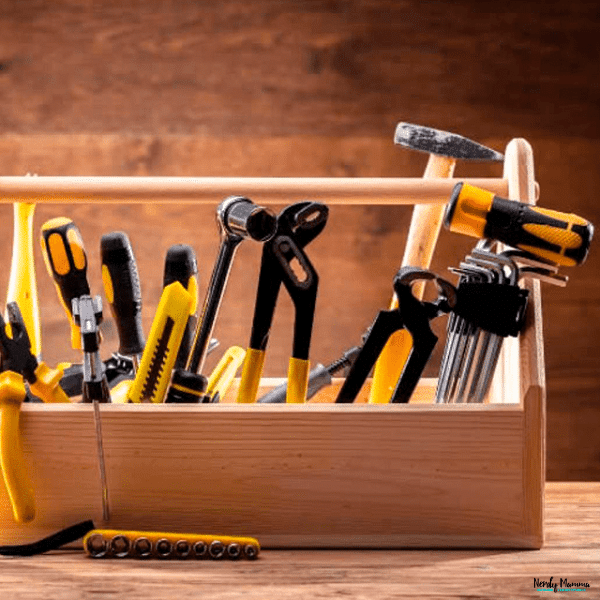
The first need when choosing a portable DIY tool kit is finding a case that will meet your expectations. As a rule, medium-sized tools with a secure latch and a convenient handle to carry are the most optimal choice.
This way, you will protect the equipment from damage and transport it without breaking any of its parts. Some homeowners decide to store their kits in hard plastic cases, while others opt for fabric bags with several pockets.
It is up to you to choose what to prefer considering the frequency of your use and the location of the storage.
Another characteristic that should not be ignored is the storage capacity. A box that is too small will soon turn out to be too small, and a large one will encourage you to fill it with unnecessary items.
The most comfortable and rational solution would be to take a case that has enough space for the most frequently used tools and additional pockets for others. The division of the tools into groups will allow you to find the necessary means much faster and minimize the loss of any components.
Tools and Equipment for Common Projects
The maintenance of any portable kit should include some universal tools. Thus, a hammer, adjustable wrench, screwdrivers, pliers, a utility knife, a tape measure, and a level can be regarded as the basics that will help repair most of the things in the house.
Moreover, every set includes universal devices that can be used in several tasks.
However, when building your own collection, it is better to focus on reliability and variety rather than on the number of tools. It is advisable to purchase the products from different manufacturers as they provide greater guarantee for the quality of tools.
In addition, such devices are usually comfortable to hold and work with. Therefore, it is safer and more convenient to choose reliable tools than to risk using some cheap and low-quality products.
Fasteners and Repair Supplies to Keep Handy
In addition to hand tools and equipment, a portable DIY toolkit should also have a selection of fasteners and repair supplies. It helps to have a small bag divided into sections with screws, nails, anchors, washers, and other similar supplies. Wall anchors and picture hanging kits are also useful in most cases.
Some basic materials can also come in handy during repairs and installations. For example, duct tape, electrical tape, wood filler, super glue, painter’s tape, zip ties, and sandpaper can be helpful in many cases.
Storing these materials in the toolkit makes the device much more useful since it enables one to get the job done without having to stop and shop for these items.
Measuring and Marking Equipment to Add
It is always essential to measure twice before cutting or drilling something. Therefore, a good toolkit should have a reliable measuring tape, a carpenter’s pencil, permanent marker, and a square. Such devices help ensure that everything is built or installed correctly without having to spend much time correcting simple mistakes.
Moreover, having the right tools for marking also helps keep everything consistent throughout a project. It is much easier to make marks to indicate the spot where something should be drilled, cut, or installed rather than trying to eyeball each spot. Taking the time to prepare things properly can save much effort and materials in the long run.

Including Basic Electrical Equipment
The majority of homeowners will need to replace outlet covers or work with light switches. A non contact voltage tester can help them ensure safety before proceeding with any electrical work. Wire strippers and screwdrivers are also necessary for people who want to perform electrical maintenance on a regular basis.
While doing electrical maintenance, safety is paramount. It is always better to call an expert if the process involves unfamiliar outlets, wiring, or a faulty system. The portable kit should help the user manage routine maintenance tasks at home and know when to seek professional help.
Preparing for Plumbing Repairs
Every portable bag begins its service by including a functional set of the most common tools that will be used for household repairs in the future. Such equipment includes a hammer, adjustable wrench, various screwdrivers, pliers, utility knife, a tape measure, and a level.
This combination covers most of the tasks needed and is suitable for a larger number of DIY projects.
It is better to buy high-quality power tools in a trusted store rather than cheap and low-performance gear. Good tools have an improved design and are much easier to work with.
In addition, they are more durable and have better ergonomic design. It would be useful to avoid a large set of mostly unnecessary devices and pay more attention to the tools required for the planned repairs.
Deciding When to Include Battery-Powered Equipment
Some people consider adding battery-powered devices to their toolkits for more versatility. Such equipment as a drill and a driver can be good additions to a portable DIY toolkit.
These tools can handle many minor home maintenance tasks while remaining lightweight and compact. As a result, homeowners can use the toolkit as a portable power solution for smaller projects.
Of course, users need to charge and maintain batteries properly to ensure the tools are ready when needed. Keeping an extra battery pack in the toolkit also helps ensure it’s always ready for immediate use.
Maintaining the Portable Tool Kit
It is essential to maintain the toolkit to ensure that everything in it is in good working condition. Sharpening tools, replacing broken or dull blades, cleaning the devices, and inspecting them for wear and tear are all rather important to ensure that the toolkit is useful.
This way, there will be fewer issues when working on minor projects or during major ones.
It is also good to keep track of everything in the toolkit. Whenever anything is used, it should be returned to the toolkit so that it does not get lost and it is available the next time it is needed.
Maintaining the toolkit helps it be as useful as possible for the person who owns it and helps them deal with the simplest home maintenance without spending too much time searching for the necessary equipment.
A portable DIY toolkit can be extremely convenient and helpful to people who want to maintain their homes on a regular basis.
Consider which devices and tools you use most often, choose a reliable storage option, keep essential fasteners and repair supplies on hand, and prepare for the most common home maintenance tasks.
In addition, maintain your tools and keep them in good working condition to create the most practical and useful toolkit possible.