
Let’s be honest: a perfectly tidy living room is a lovely idea… in theory. In real life (which includes kids, work, and the invisible mental load most moms carry), we can scale it back to maintaining a space that feels calm enough to function.
Research shows that women still manage the majority of household responsibilities, about 71% of family tasks, including organizing and planning. Add toys, laundry, and the daily swirl of family life, and it’s no surprise that the living room often becomes a catch-all space.
But here’s the good news: your living room doesn’t need to be spotless to feel put together. With a few intentional systems and realistic expectations, it can become a space that supports your family instead of stressing you out.
Why “Mostly Put Together” Is the Goal
Before diving into tips, it’s worth redefining success. A “perfect” living room isn’t the goal; a functional, low-stress one is.
Studies show that cluttered environments are linked to higher stress levels, particularly for women, who experience increased cortisol in messy homes.
Household chaos, defined by clutter, noise, and lack of routine, has also been associated with negative outcomes for both parents and children.
Visual clutter is “an overwhelming amount of elements… that make it difficult to focus.”
Start With the Right Foundation
One of the biggest mistakes busy moms make is trying to organize on top of a space that doesn’t work.
Your furniture layout matters more than you think. A living room that’s too crowded, or not designed for how your family uses it, will never stay tidy for long.
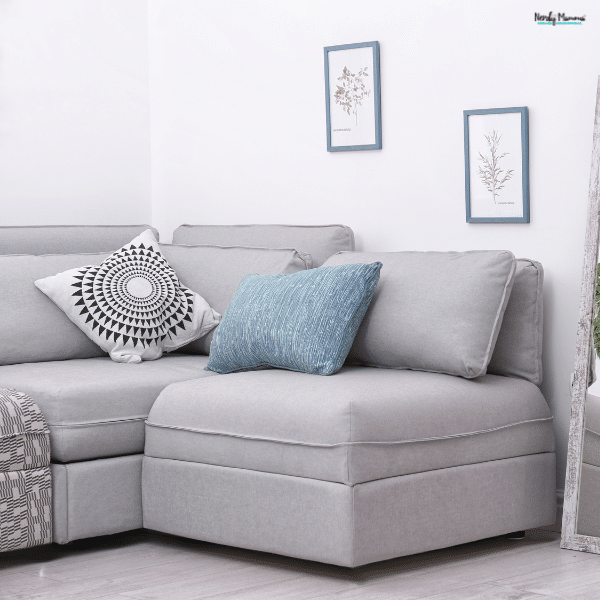
This is where choosing practical, family-friendly furniture becomes key. For many households, sectional couches offer a flexible solution: they define the space, provide ample seating, and reduce the need for extra chairs that can create visual clutter.
The takeaway? Start with a layout that supports real life: movie nights, snack time, and yes, the occasional toy explosion.
Create “Drop Zones” That Actually Work
Clutter builds up where systems don’t exist.
Think about your living room right now. Where do things naturally land? Backpacks, remote controls, blankets, random LEGO pieces? Those are your problem zones.
Instead of fighting them, design around them:
- A basket for throw blankets
- A tray for remotes and chargers
- A small bin for “things that belong elsewhere”
- A designated toy basket (or two)
Giving everything a “home” reduces the time spent searching for items and keeps clutter from spreading.
The trick is to make these systems easier than making a mess.
Use the “Little and Often” Method
If you’re waiting for a full free afternoon to clean your living room… it’s probably not happening.
Instead, embrace the “little and often” approach: short, consistent bursts of tidying.
Professional organizers recommend tackling one small area at a time, like a drawer, toy bin, or coffee table, rather than attempting a full reset.
What this looks like in real life:
- A 10-minute reset before bed
- A quick tidy during screen time
- A Sunday basket sweep of stray items
These small habits prevent clutter from reaching overwhelming levels—and they’re far more realistic for busy moms.
Rethink Toy Storage (Without Hiding Your Kids)
Let’s talk about the elephant in the room: toys.
They’re not going anywhere and they shouldn’t. But they can coexist with a calm, functional space.
A few practical strategies:
- Rotate toys to reduce volume
- Use closed storage to limit visual clutter
- Keep only a small selection in the living room
- Involve kids in clean-up routines
Experts often note that too many visible items (even when neatly arranged) can create visual overwhelm.
Translation: fewer toys out = a calmer-looking room (even if the house isn’t spotless).

Design for Real Life, Not Instagram
A living room that works for your family will never look like a showroom and that’s okay.
In fact, overly styled spaces can make daily life harder. Too many decorative items, oversized furniture, or impractical layouts can contribute to clutter and frustration.
Instead, ask yourself:
- Can my kids play here without constant “don’t touch that”?
- Is everything easy to put away quickly?
- Does this space feel relaxing at the end of the day?
If the answer is yes, you’re doing it right.
Build Simple Systems (Not Complicated Rules)
The most organized homes don’t rely on constant cleaning. They rely on systems.
Think:
- A weekly reset routine
- A “one in, one out” rule for new items
- A family clean-up habit before dinner or bedtime
Research shows that consistent routines and organization systems help reduce stress and create a more harmonious home environment.
The key is simplicity. If a system is too complicated, it won’t last.
Let Go of the Guilt
Here’s something that doesn’t get said enough: a slightly messy living room doesn’t mean you’re failing.
In fact, trying to maintain unrealistic standards can create more stress than the mess itself.
Clutter becomes a problem when it overwhelms your space and your mind—not when your kids leave a few toys on the floor after a long day.
Your home is meant to be lived in. Laughed in. Relaxed in.
Sometimes “mostly put together” is more than enough.
Conclusion
Creating a living room that stays (mostly) put together isn’t about achieving perfection.
By choosing furniture that works for your lifestyle, building simple systems, and embracing realistic habits, you can create a space that feels calm, functional, and welcoming, even on the busiest days.
Because at the end of the day, the goal isn’t a picture-perfect room. It’s a home that works for your family and gives you just a little more breathing room in the process.
