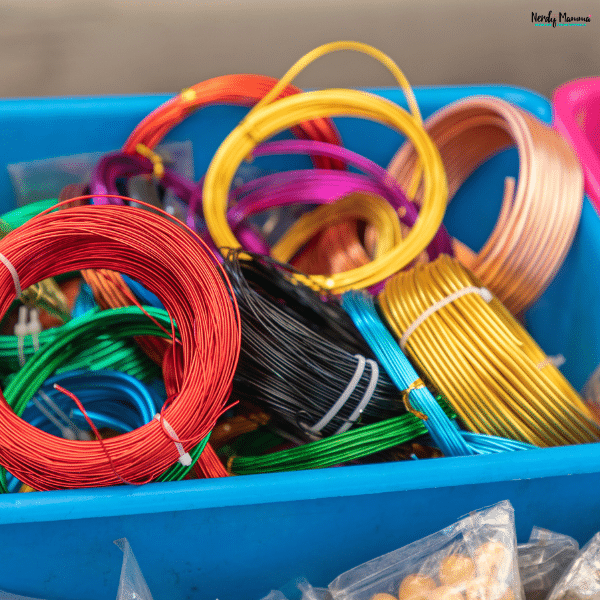
You’re halfway through a coil of bright red craft wire, and every time you open your steel pliers, there’s a fresh dent and a shiny streak where the steel scraped off the color.
And if the wire takes a sharp kink along the way, it keeps a ripple you’ll still see, however carefully you straighten it. For colored and plated craft wire, what you want is a pair of parallel-action pliers with nylon or soft plastic jaws, in a hardness that suits your wire. Add a round-and-flat pair for loops.
Why Does Colored Craft Wire Need Soft Jaws?
Colored craft wire needs soft jaws because its color is only a thin layer over bare metal, and steel jaws dent the wire and scrape through that layer. That layer is colored enamel on enameled copper, a dyed surface on anodized aluminum, and a skin of silver or gold on plated wire.
Nylon is smooth and much softer than steel, so nylon jaws give a little around the wire instead of pressing a dent into it.
What Should You Look for in Soft Jaw Pliers?
Three things matter: how soft the jaws are, what shape they are, and how they close.
Soft Plastic, Nylon or Hard Nylon: Which Jaws Do You Need?
For ornaments and everyday jewelry, start with a pair that has nylon or hard nylon jaws, and add a second pair with soft plastic jaws if you work with a lot of plated wire. Soft plastic is the gentlest on delicate finishes like silver plate and on fine 24 and 26 AWG wire.
In the American wire gauge (AWG) system, higher numbers mean thinner wire. Soft plastic does give under force, though. Squeeze hard and the plastic squashes, the wire rolls, and your bend lands somewhere you didn’t plan.
Hard nylon holds firmer and more precisely on thicker wire like 18 AWG, about 0.040 inch (1.0 mm) thick, so corners come out crisp. Regular nylon sits in between.
Which Jaw Shape Do You Need: Flat or Round-and-Flat?
Flat jaws are for straightening wire, gripping it for sharp bends, and pressing a spiral or a wobbly wrap flat.
A round-and-flat pair has one round jaw for loops and one soft flat jaw. You roll the wire around the round jaw while the flat jaw holds it from the outside. Loops and curves come out smooth, with no marks on the side people see.
Why Do Parallel Jaws Grip Better Than Scissor-Style Jaws?
Parallel-action jaws stay parallel as they close, so they hold the wire evenly along their whole length and it doesn’t slide toward the tip as you squeeze.
Most pliers pivot like scissors instead, so the jaws close at an angle and push the wire out toward the tips. (Yes, that’s a lot of feelings about a hinge.)
Which Soft Jaw Pliers Should You Buy?
Maun’s soft jaw pliers have parallel-action jaws, which makes them a good choice for shaping and straightening colored or plated craft wire without marking it. Maun makes each pair with one of three kinds of jaw: soft plastic, nylon or hard nylon.
Pick the pair whose jaws suit the wire you use most. For loops, Maun’s round-and-flat pairs combine one tapered round jaw with one flat jaw in nylon or soft plastic.
Expect to pay £38 to £45 a pair at November 2026 prices.
What You Need for Your First Colored-Wire Project
A five-point star ornament makes a friendly first project: mostly straight lines and sharp bends, and a wonky point just looks handmade (that’s the official line, anyway). You need:
- Flat nylon jaw pliers for straightening and holding the wire.
- Round-and-flat soft jaw pliers for the hanging loop.
- Flush cutters, because soft jaw pliers don’t cut.
- 18 AWG colored craft wire, about 20 inches (508 mm) for each star.
- A ruler and a dry-erase marker for marking the bends.
- Ribbon or an ornament hook for hanging the star.
- Safety glasses, since snipped wire ends fly.
How Do You Straighten and Shape Colored Wire Without Stripping the Color?
The flat nylon jaws hold the wire; your thumb and fingers bend it.
1. Cut about 20 inches (508 mm) of 18 AWG wire with flush cutters.
2. Pinch one end of the wire and close the flat nylon jaws beside your fingers. Pull the pliers to the other end in one slow, steady stroke. Repeat two or three times, until the wire lies straight. Each pass work-hardens the wire a little, which helps the star hold its shape. Stop once it’s straight, though, because over-hardened wire cracks at a sharp bend.
3. Mark the wire 3 inches (76 mm) from one end, then make three more marks 3 inches (76 mm) apart.
4. Grip the wire in the flat nylon jaws with the jaw edge on the first mark, then push the long end around the jaw edge with your thumb until the two sides close into a narrow V.
5. Fold at the other three marks the same way, bending in the same direction each time. The wire crosses itself, like a doodled notebook star, and returns to the starting end to form the fifth point. If a point lands badly (it happens), unfold it once and refold. Bend one spot back and forth, though, and the wire cracks there.
6. Hold the fifth point in the flat nylon jaws and wrap the long tail twice around the starting end, right beside the point. Squeeze the wraps snug with the jaws.
7. Bend the rest of the tail straight up and trim it to about 3/4 inch (19 mm) with flush cutters. Grip the end in the round-and-flat pliers, round jaw on the inside of the curve, and roll the wire around the round jaw into a simple loop. For a sturdier hanger, skip the trim and make a wrapped loop instead.
8. Hold the star by one point in the flat nylon jaws and nudge any crooked sides straight with your fingers. Wipe off the marker and add the ribbon or hook.
When Shouldn’t You Use Soft Jaw Pliers?
Soft jaw pliers don’t cut, so keep flush cutters handy. You can roll small loops on a round-and-flat pair with a fine round tip. But the very smallest eyes, like the small eye on an earring wire, need round-nose steel pliers.
Heavy gripping and thick steel wire squash soft jaws and press grooves into them.
Grooved jaws trap grit, and the grit scratches the next colored wire you hold. Keep soft jaw pliers away from heat and soldering, too. A torch or soldering iron softens nylon, and hot wire melts a groove into the jaw.
Is it Ever OK to Use Plain Steel Pliers?
Absolutely. For bare copper or steel wire you’ll hammer or tumble-polish anyway, steel chain-nose or flat-nose pliers are fine. The hammer flattens small dents along with the wire, and the tumbler smooths light scratches.
Nobody hands out prizes for protecting the finish on wire you’re about to hit with a hammer. Save the nylon jaws for wire with color worth keeping.
Soft Jaw Pliers FAQ
What are soft jaw pliers or?
Soft jaw pliers are for holding, bending and straightening colored, enameled, anodized and plated wire without denting it or scraping off the color. The jaws also hold findings and finished pieces without scratching them.
Will nylon jaw pliers scratch silver-plated wire?
Clean, smooth nylon jaws shouldn’t. If you see scratches, check the jaws for grit or metal flakes and wipe them clean. Jaws with a worn groove will keep marking the wire. On very thin plating, use pliers with softer jaws and a lighter squeeze.
Can you straighten wire with nylon jaw pliers?
Yes: pull the wire through the closed flat jaws two or three times. That takes out spool curl and gentle bends. A sharp kink leaves a ripple you’ll still see, so cut it out of anything on display.
What gauge wire can soft jaw pliers handle?
Soft jaw pliers suit the fine and medium craft wire used for jewelry and ornaments. Thick steel wire squashes the jaws, so use steel pliers for it. If the packaging on your pliers lists a gauge range, follow it.
