
Key Takeaways
- Outdoor play works best when it feels like a game, not a workout, so kids burn energy through play and barely notice the movement.
- The best backyard activities for kids match your child’s age, energy level, space, mood, and confidence.
- Backyard activities for kids are great for quick movement breaks between meals, chores, or screen time.
- Park activities for kids give more room for climbing, sprinting, riding, and group games that burn more energy.
- Everyday items like sticks, leaves, sidewalk chalk, and a bucket of water can turn a plain yard into active outdoor play, no fancy toys required.
- A flexible 20-minute outdoor routine can reset the mood on busy days and help your child practice gross motor skills, balance, and coordination.

Introduction
Some kids seem to save their biggest burst of energy for the moment you start making dinner or preparing for bath time.
When children start bouncing on the couch or asking for more screen time, they often need active play instead. A backyard, driveway, sidewalk, or local park can provide the perfect outlet. Better yet, you do not need a large yard to keep kids moving and engaged.
This guide shares practical backyard and park activities for toddlers, preschoolers, and young children. It also includes a simple activity picker, a 20-minute movement routine, important safety tips, and answers to common questions. As a result, you can help kids burn energy while having fun outdoors.
Why Outdoor Play Works So Well for Busy Kids
Outdoor play works because it matches how children move. Kids run, climb, crawl, squat, jump, reach, stop, and turn without thinking of it as exercise. They are simply playing, and that play quietly builds real physical health.
Outdoor play does more than burn energy. It also helps children develop important gross motor skills. These large muscle movements include running, hopping, climbing, and balancing. As a result, kids improve their coordination, body control, and core strength.
Activities such as climbing and riding encourage both physical development and confidence. For example, children learn how to balance on a curb or steer around a corner while practicing new skills.
In addition, outdoor play creates valuable learning opportunities. Counting natural objects supports early math skills. Sorting sticks, rocks, and leaves helps children recognize patterns. Meanwhile, observing birds, clouds, and plants strengthens their awareness of the natural world.
Outdoor adventures also encourage imagination and communication. When children create characters and tell stories during play, they practice language skills and social interaction in a fun and natural way.
According to CDC physical activity guidance for children, children ages 3 to 5 should be physically active throughout the day to support growth and development, and children and adolescents ages 6 to 17 need at least 60 minutes of moderate-to-vigorous physical activity daily.
The CDC also encourages choosing age-appropriate, enjoyable activities. Many parents aim for at least an hour of active outdoor play most days as a practical target, and the reassuring part is that it does not have to happen all at once.
Every day play, walking, chasing, climbing, and riding all count, and short bursts add up over an afternoon.
For toddlers, outdoor play may mean short bursts: chase bubbles, carry sticks, ride a small loop, then take a water break. Preschoolers may need to repeat one obstacle course until they feel proud of it.
For bigger kids, it may mean races or inventing rules. The activity changes, but the goal stays the same: to give children a playful way to move outdoors.
Screens already fill much of the day: the 2025 Common Sense Census found that kids ages 5 to 8 average almost three and a half hours of screen media daily, and most parents say they worry about it.
A few short bursts of outdoor play will not erase that, but they give your child a reliable, repeatable way to move.
Quick Activity Picker for Parents
Scan the table and pick an activity based on your child’s age, the space you have, and how much energy you need to burn before the next transition. This works whether you have five minutes or an hour.
| Activity | Best For | Backyard or Park | Energy Level | Skill Built | Parent Prep |
| Chalk obstacle course | Toddlers, preschoolers, young kids | Backyard, driveway | High | Balance, jumping, motor planning | 2-minute chalk setup |
| Backyard obstacle course | Preschoolers, young kids | Backyard | Very high | Gross motor skills, coordination | Gather yard items |
| Bubble chase | Toddlers, preschoolers | Backyard, park | Medium to high | Running, reaching, coordination | Bubbles |
| Animal walk races | Toddlers, preschoolers | Backyard, grass | Medium | Upper body strength, body awareness | None |
| Nature color hunt | Toddlers, preschoolers | Backyard, park | Low to medium | Observation skills, color recognition | Color card |
| Water games | Toddlers, preschoolers, young kids | Backyard | High | Running, pouring, motor skills | Bucket, sponges, cups |
| Hula hoop and dancing | Toddlers, preschoolers | Backyard, park | Medium to high | Balance, coordination, motor planning | Hoops or music |
| Red light, green light | Preschoolers, young kids | Backyard, park | Medium to high | Stopping, listening, body control | None |
| Balance-bike driveway loop | Toddlers | Driveway, smooth path | Medium to high | Balance, coordination, confidence | Helmet, safe space |
| Playground circuit | Preschoolers, young kids | Park | Very high | Climbing, strength, and agility | None |
| Hill climbs | Preschoolers, young kids | Park | High | Leg strength, stamina | None |
| Tree-to-tree races | Young kids | Park, open grass | High | Running, direction changes | None |
| Nature scavenger walk | Toddlers, preschoolers | Local park, trail | Low to medium | Walking, observation, calm focus | Verbal list |
| Ball and group games | Mixed ages | Park, field | Medium to high | Hand-eye coordination, turn-taking | Ball, cones |
Backyard Activities That Burn Energy Fast
These backyard activities for kids work after daycare, after dinner, or on lazy summer weekends. Each one can scale up or down for toddlers, preschoolers, and bigger kids.
Rotate three or four favorites through the week so you are not reinventing the wheel every afternoon, and most use natural materials or items you already have around the house.
Chalk Obstacle Course
Grab a box of sidewalk chalk and create a winding path across your driveway, patio, or sidewalk. You can draw hopscotch grids, arrows, zigzags, circles, stars, and stop markers to make the course more exciting.
Next, add simple movement challenges along the route. For example, ask kids to jump over a pretend river, spin on a star, hop on one foot, bear crawl to an arrow, or freeze at a stop point.
For toddlers, keep the path short and use large, colorful shapes. You can also add simple color-matching or number-recognition activities to make the game more engaging.
Older children may enjoy timed challenges or designing their own obstacle course. As a result, the activity stays fresh and encourages creativity.
Sidewalk chalk games help children practice fine motor skills and motor planning. In addition, jumping, hopping, and balancing support physical development while requiring very little setup.
Backyard Obstacle Course With Real Yard Stuff
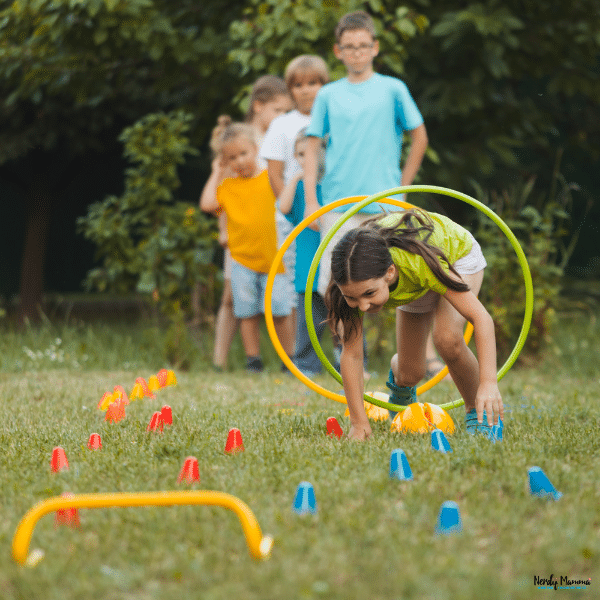
A backyard obstacle course can be created using household items you already own.
Create a simple obstacle course using items you already have at home. Move patio furniture into place for crawling stations. Place a hula hoop on the ground for jumping activities. You can also stretch painter’s tape between two chairs to create a balance line and set out a laundry basket for ball tossing.
In most cases, four to six stations are enough to keep children engaged. Because you are using existing outdoor items, setup remains quick and easy.
To add variety, include animal movements such as bear crawls, crab walks, or frog jumps. These activities help children develop upper-body strength, balance, and body awareness.
Obstacle courses also encourage coordination and listening skills. As children move from one station to the next, they learn to follow directions and complete movement sequences. As a result, obstacle courses provide an effective way for toddlers, preschoolers, and older children to stay active while having fun.
Oversized versions of classic games can challenge balance and coordination when you scale up the distances. Encourage kids to help design the course on weekends so they feel a sense of ownership and stay engaged.
Bubble Chase
Bubble chase is a good pick for kids who need movement but do not want rules. Blow bubbles and let children run, reach, jump, pop, and turn as they chase them. For toddlers, blow bubbles low and close so they can track them. For preschoolers, raise them higher to add running and jumping.
When a child is already cranky, skip instructions at first, just blow bubbles and let them join when they are ready. This is one of those screen-free activities for kids that can fill five minutes or twenty.
Animal Walk Races
Animal walks turn movement into pretend play. Call out an animal, then let kids move like it across the yard or grass: bear crawls, frog jumps, crab walks, bunny hops, duck waddles.
For toddlers, keep the distance short and focus on copying the movement. For bigger kids, turn it into a relay. Animal walks develop upper-body strength and body awareness because kids push, crawl, balance, and squat while using their large muscles.
Nature Color Hunt and Backyard Bingo
Hand each child a homemade color card with blocks of green, brown, yellow, purple, and gray, and send them on a nature color hunt.
Nature color hunts give toddlers a sensory experience and help children identify colors in their environment: green leaves, brown mulch, yellow dandelions, gray stones, and white clouds.
Encourage kids to collect sticks, leaves, and small stones and create a nature collage back at the table. Gathering and sorting natural objects enhances learning experiences as kids group their nature treasures by size, shape, or texture and start to recognize patterns.
Counting what they find gives toddlers a chance to practice early math, all while they walk and explore the yard. Turn it into backyard bingo with picture icons for kids who are not reading yet.
This is a calmer pick for days when kids need fresh air without intense running, and it leans on natural materials you find on the ground.
Water Games for Hot Days
Water games are a summer favorite and one of the best ways for kids to burn energy on hot afternoons. Set up a sponge relay: soak a sponge, run to a bucket, squeeze it in, race back.
Try a cup-to-cup transfer race, or let kids spray chalk drawings off the driveway with a hose. Water play activities can include using a splash pad or water balloons for extra excitement, and setting up a water table for toddlers to scoop, pour, and fill with gardening buckets.
Add food coloring to the water for visual fun, or let kids “paint” with washable paint and erase it with streams of water. DIY water walls can be built using recycled plastic bottles attached to a fence, so kids pour water in the top and watch it flow down.
All this water play builds motor skills and a sense of cause and effect, though it always needs close adult supervision, especially with toddlers.
Hula Hoop and Dancing Games
Lay hoops on the ground like lily pads to hop between with two or one foot, roll a hoop across the yard for kids to chase, or spin it and challenge them to jump over it before it falls. Put on a song and let everyone move however they want, because dancing gives kids practice with balance, coordination, and motor planning.
These work well for short bursts of energy while dinner is on the grill. Keep it playful, not competitive, with no scorekeeping needed, and the silliness usually makes the movement more fun.
Balance-Bike Driveway Loop
A riding loop is a great way to help toddlers build balance and coordination while staying active outdoors. It works especially well for children who enjoy moving quickly but are not yet ready for pedal bikes.
Create a short route on a smooth driveway, a wide sidewalk, or a quiet park path away from traffic. Then, use chalk stars, cones, or other markers to outline the course. These visual guides help children follow the route and stay focused on the activity.
As toddlers ride around the loop, they practice steering, balance, and spatial awareness. In addition, the repeated movement helps improve confidence and coordination. Best of all, a simple riding loop requires very little setup and can provide plenty of active outdoor fun.
For toddlers who are not ready for pedals yet, a lightweight 12-inch balance bike, light enough for a small child to lift and steer, with a low step-through frame for confident starts and stops, lets them scoot a driveway loop or smooth park path while building balance, coordination, and confidence with every lap.
Keep the riding loop short and make sure your child wears a properly fitted helmet. To keep the activity engaging, add simple challenges along the route. For example, ask your child to ride to a chalk star, stop at a cone, and then coast back to the starting point.
A clearly marked course often works better than simply telling a child to ride around. Young children are more likely to stay active when they know where to begin, where to stop, and what to do next. As a result, a simple riding loop can encourage more movement while helping toddlers build confidence and coordination.

Park Activities for Bigger Movement
Parks give kids more room to move their whole bodies, with space to sprint, climb, and explore without worrying about patio furniture or fences.
A playground, grassy field, small hill, or paved path at your local park can become a movement course. Bring a ball, some chalk, a hula hoop, or just your imagination.
Playground Circuit
Turn the playground into a loop: climb the ladder, cross the bridge, slide down, run back to the start, repeat. Balance beams and seesaws give kids practice with balance, and climbing builds grip, agility, and confidence as they solve small movement problems, such as where to put their feet.
For hesitant kids, pick one challenge, because “climb the steps and slide once” may be plenty. For high-energy kids, count circuits together, then add a water break.
Hill Climbs
A small grassy hill can be one of the best ways for kids to burn energy. Walk up and tiptoe down, run halfway and walk the rest, climb like a bear, or carry a leaf treasure to the top.
Choose a hill with a clear path and soft ground, and avoid steep, slippery, or crowded slopes. If your child gets frustrated, make the goal smaller. Walk to the base, climb halfway, then celebrate, because the win is movement, not distance.
Tree-to-Tree Races and Field Games
An open grassy area is all you need. Pick two landmarks, such as a tree and a bench, and ask your child to move between them in different ways: run to the tree, march to the bench, hop back, crab-walk halfway.
Red light, green light requires no equipment to play, just a caller and some willing runners. Hide-and-seek is a classic outdoor game for all ages that requires nothing but space.
These games give kids practice with listening, impulse control, and changes in direction, and a landmark gives the play a clear beginning and end.
Nature Scavenger Walk
A nature walk is a good pick when your child needs time outdoors but not wild running. Ask them to find one smooth rock, one rough rock, something yellow, a bird sound, and a cloud shape. Explore safe low curbs, logs, or stepping stones for balancing to build body awareness on uneven ground.
Let kids sense different textures and talk about what they discover in the natural world. This lower intensity activity supports calm focus and lets toddlers explore the local park at their own pace, a good bridge back to calm after a loud playground.
Ball Games and Group Games
Kids do not need formal teams to enjoy ball play. Roll a ball down a small hill, kick it between two trees, or toss it into a park bag. Playing catch gives preschoolers and school-age kids practice with hand-eye coordination and motor skills.
For groups with children of different ages, choose activities that keep everyone involved. Games such as Sharks and Minnows work well in large outdoor spaces and encourage plenty of movement. Capture the Flag is another popular option that promotes teamwork, strategy, and active play.
Jump rope games also provide a simple way to keep kids moving. In addition, classic lawn games such as cornhole and bocce ball are great choices for family gatherings. Older children may also enjoy activities like tetherball or swingball, which help develop hand-eye coordination and reaction skills.
When younger and older children play together, encourage older siblings to take on helper roles. They can draw activity courses, call out instructions, or set up markers for games. Most importantly, focus on fun, cooperation, and taking turns. This approach helps everyone stay engaged and enjoy the activity together.

A 20 Minute No-Prep Outdoor Routine
Use this routine when you need a clear plan but do not want to overthink it. It works in a backyard, driveway, sidewalk, or park, and it is a flexible play template rather than a workout. Adjust for weather and mood.
- Minutes 1 to 5, warm-up: chase, bubbles, or animal walks. Choose a movement that feels playful right away.
- Minutes 6 to 12, main energy burst: a chalk or backyard obstacle course at home, or a playground circuit at the park. Let kids choose, because they work harder when the idea is theirs.
- Minutes 13 to 17, riding or running loop: a balance-bike loop, scooter loop, or a cone-to-cone run. A short loop works well because kids know where to go and what comes next.
- Minutes 18 to 20, cool-down: play nature I-spy, find three colors, walk slow laps, then take a water break on the porch.
If you only have 10 minutes, use the same pattern in miniature: 3 minutes of fast movement, 4 minutes of a main game, and 3 minutes of slower walking or nature spotting. If your child is already tired, start with the calmer part first.
Safety Tips That Keep Outdoor Play Low-Stress
A few habits keep outdoor play manageable for parents, too, so the whole family can enjoy the physical health benefits of moving outdoors. This is parent-to-parent guidance, not medical or legal advice. Trust your local conditions and your own judgment.
- Match the activity to your child’s age, size, confidence, surroundings, and mood.
- Use closed shoes for running, climbing, and riding, and a helmet for any riding activity.
- Keep water bottles filled, add sun protection and shade breaks on hot days, and layer up in cooler months.
- Scan playground equipment and riding surfaces for loose parts, gravel, or slippery ground.
- Encourage clear boundaries before play starts, such as “stay inside the fence” or “do not pass the bench,” and repeat them in plain language.
- Any water play, even a few inches in a bucket, needs constant adult supervision within arm’s reach for toddlers.
- At a public park, choose a meetup spot under a certain tree or near a bench so everyone knows where to go.
As pediatrician Michael Yogman, MD, FAAP, lead author of the American Academy of Pediatrics report The Power of Play, puts it: “Play helps children learn language, math, and social skills, and lowers stress.”
FAQ
What are good backyard activities for kids with lots of energy?
Good backyard activities for kids with lots of energy include chalk obstacle courses, backyard obstacle courses, bubble chase, animal walks, red light green light, water relays, and hula hoop games.
The right choice depends on your child’s age, the space you have, and how much energy you want to burn before the next transition.
What outdoor activities work best for toddlers?
Activities for toddlers work best when they are short, playful, and built around movement they already enjoy.
Bubble chasing, animal walks, nature color hunts, short riding loops, water pouring games, and slow scavenger walks are all toddler outdoor play ideas that work well with adult supervision and simple toys like a ball or a bucket.
How can I help my child burn energy without screens?
Use screen-free activities for kids that mix movement with play: obstacle courses, playground circuits, field races, ball games, and nature hunts.
If your child resists going outside, start with a five-minute game tied to something they already like, such as bubbles, animals, or a treasure hunt. Cutting screen time gets manageable when the outdoor option feels more fun than the tablet.
How long should outdoor play last?
It depends on your child’s age, the weather, and your routine.
Toddlers and preschoolers often do well with several short bursts of active outdoor play during the day, while school-age kids can work toward the CDC recommendation of 60 minutes or more of moderate-to-vigorous physical activity daily. Walking, running, climbing, riding, and tag all count toward the total.
What can I do when my child is cranky or overstimulated?
Calmer activities often work better than running games when a child is overwhelmed. Try a slow nature walk, quiet chalk drawing, cloud watching, or swinging.
Outdoor dramatic play, where kids invent and narrate a story, offers a gentle way to practice language and social skills as they wind down. After dark, a shadow puppet theater made with a flashlight and a sheet is a calm way to stay outdoors a little longer.
What about rainy days or when active play wraps up early?
On rainy days, you can easily adapt outdoor activities to a covered porch or garage. For light rain, dress children in layers and waterproof jackets so they can continue enjoying time outside comfortably.
If active play ends earlier than expected, consider other outdoor activities that keep the family engaged. An outdoor movie night with a projector and a simple screen can create a memorable evening. You can also try a backyard science activity, such as making a homemade volcano.
These simple alternatives help children spend more time outdoors, even when the weather is less than perfect. As a result, families can enjoy fresh air and quality time together throughout the year.
These are calmer add-ons, not energy burners, so pair them with a real movement session earlier in the day.
Are balance bikes good for active toddlers?
Balance bikes are a great outdoor activity for toddlers who are learning to steer, stop, balance, and coordinate their movements. They provide a fun way for young children to build confidence while developing important motor skills.
For the best experience, keep riding sessions short and age-appropriate. Always make sure your child wears a properly fitted helmet. In addition, choose a smooth riding surface that is free from traffic and major obstacles. Stay nearby so you can offer guidance and step in quickly if needed.
With the right setup, balance bike activities can help toddlers stay active while safely improving balance, coordination, and overall confidence.

Conclusion
Kids do not need complicated plans to stay active. A backyard, sidewalk, driveway, playground, or local park can become the perfect screen-free play space. The key is choosing activities that match your child’s age, interests, confidence level, and environment.
Some days may call for running games and obstacle courses. On other days, blowing bubbles or taking a nature walk may be a better fit. Even a simple challenge, such as finding three yellow objects before heading inside, can make outdoor time more engaging.
Whenever possible, let your child help choose the activity. Giving them a role in the planning process can increase excitement and participation. Start with one simple idea, head outside, and let active play take the lead.
About the Author
Gulya Nizamieva is the Marketing Manager at Biky Bikes Corp. in Huntington Beach, California, where she leads the U.S. launch of Biky, some of the lightest bikes built for kids.
An experienced marketing specialist with more than a decade in the industry, she has run large-scale campaigns for international brands including Samsung, Sony, Toyota, and Brother, and previously worked as a senior account manager at Dentsu.
She writes about helping families swap screen time for confident, active, outdoor play.